Summary: McKinsey has signed its third AI alliance of 2026, this time with Cognition, the company behind the coding agent Devin. The tools keep changing because McKinsey’s real asset is client stickiness. That stickiness is buying MBB and tier-two firms time, not protection.
- McKinsey’s alliance with Cognition, announced on 16 November 2026, is its third AI partnership of the year.
- A McKinsey survey of 334 product and engineering leaders found nearly 30% saw productivity fall after adopting AI.
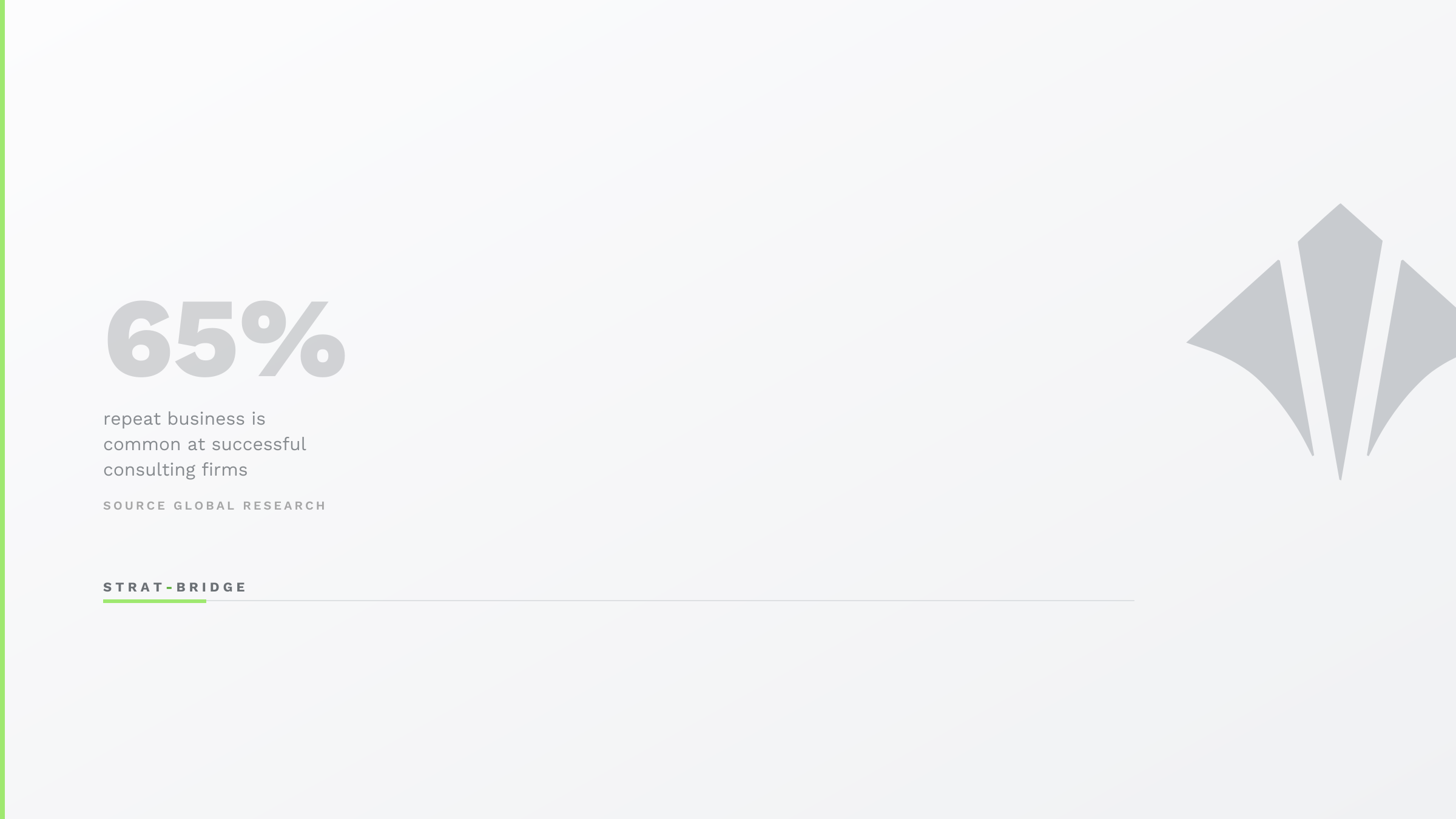
- Client stickiness in consulting is real: Source Global Research found repeat business of 65% is common for successful firms, and 80% is not unheard of.
- Client stickiness protects the consulting relationship, but not the fee model.
McKinsey keeps adding AI partners. The role it wants to play does not change.
On 16 November McKinsey and Cognition announced an alliance on agentic engineering. Cognition brings Devin, its AI coding agent, while McKinsey picks the engineering projects and redesigns the teams.
It is McKinsey’s third deal of this kind in 2026. OpenAI signed it up as a Frontier Alliance partner in February, when OpenAI chose its consulting corner. Cursor followed in July.
The pitch is the same each time. Choosing the tool is the easy bit. The fees are in getting a large organisation to work differently.
McKinsey surveyed 334 product and engineering leaders for Beyond the copilot, published in August. The top quarter said AI had more than doubled productivity. Nearly 30% said it had fallen. The figures are self-reported, but the gap is wide.
So the question is not which tool McKinsey sells next. It is why clients keep asking McKinsey to install it.
Client stickiness is buying the big strategy firms time. It is not buying them safety.
Client stickiness lets McKinsey swap the tool and keep the client
Client stickiness lets McKinsey change AI partners without changing what it sells. After all, clients are buying the relationship and the redesign, not the software.
From a boardroom’s point of view, Devin, Cursor and OpenAI’s agents are close to interchangeable. McKinsey says it has helped more than 50 companies reshape software development for AI. Its playbook covers operating model, talent and change management.
The showcase client for the Cognition deal is Comarch, the Polish ERP software company. It is using Devin to rebuild a 20-year-old system in 18 months rather than five years.
That is a strong proof point. It is also a reminder of who owns the client. Cognition supplies the engineering capacity, and McKinsey keeps the seat at the table.
Why MBB client stickiness runs deeper than the brand
MBB client stickiness rests on repeat business and on the risk a board takes in dropping a firm it knows.
Source Global Research looked at why clients keep coming back. It found repeat business of 65% is common for successful consulting firms, and 80% is not unheard of. Its explanation is simple. Around 70% of clients who know a firm well rate its work highly. By contrast, only 58% of those who know it less well say the same.
The alumni network adds another layer. A former consultant running a client’s transformation office rarely hands a board-level programme to an untested firm. It is the pattern behind McKinsey alumni as clients.
I spoke to a partner at one of the MBB firms this month who was candid about it. His view was that the big firms have become too large to move quickly. More AI-native models, he thought, are probably already doing this work better.
What protects them, he said, is how sticky the relationships are. It will take a while before a client leaves an MBB for an upstart. First, the boardroom has to be ready to accept that level of risk.
That is the honest version of the moat. It is not that the incumbents are faster.
Changing advisers is a risky decision for the people who sign the contract. That is the moat, and it is a slow one.Ben Appleton, Strat-Bridge
Tier-two stickiness sits with the partner, not the logo
In tier-two strategy firms such as Kearney and Oliver Wyman, client relationships tend to follow the partner more than the brand. As a result, that stickiness is more portable and more fragile.
When a tier-two partner moves, a meaningful part of the client book can move too. That is why the team move as a growth lever has become one of their quickest routes to new revenue.
It cuts both ways in an AI market. A tier-two firm can change its delivery model faster than a firm the size of McKinsey. But it has less brand cover when a client asks whether fewer people could do the same work.
Tier-two firms also win a lot of mid-market work. There, price is only part of the decision, but it is never far away. That is exactly the work where an AI-native challenger can compete on cost.
Client stickiness protects the relationship, not the fee model
Client stickiness keeps the incumbent in the room. It does not stop clients asking for fewer consultants and fees linked to results.
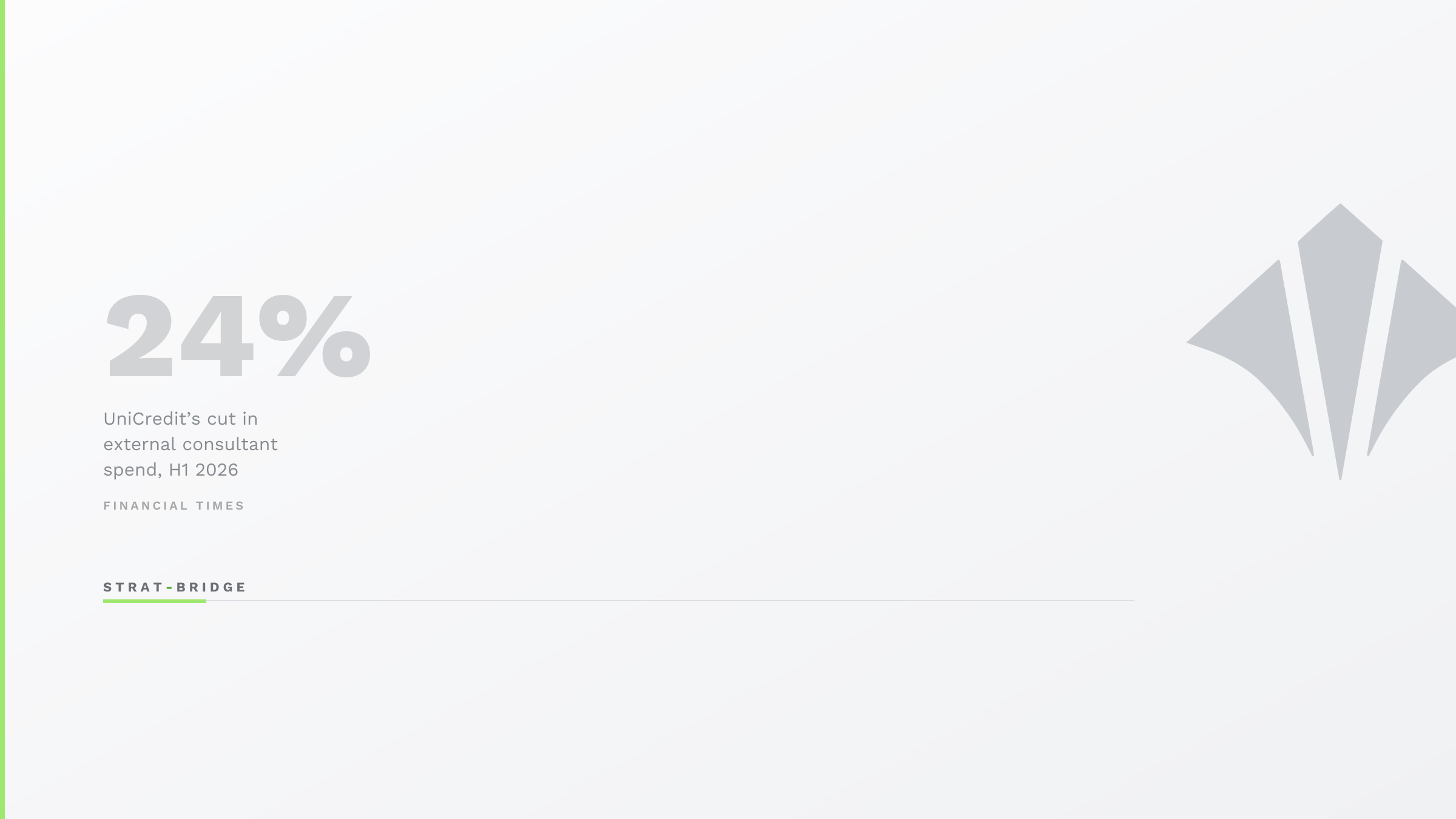
The Financial Times reported in August that Bayer has 30 AI agents supporting coding and testing on its SAP overhaul. The aim is far fewer consultants on each deployment. The same FT report on the client showdown said Bristol Myers Squibb wants fixed-price and performance-linked fees from its advisers.
It also cited research finding that only one in three clients described an externally overseen IT transformation as wholly successful. Loyalty survives numbers like that. Pricing power does not.
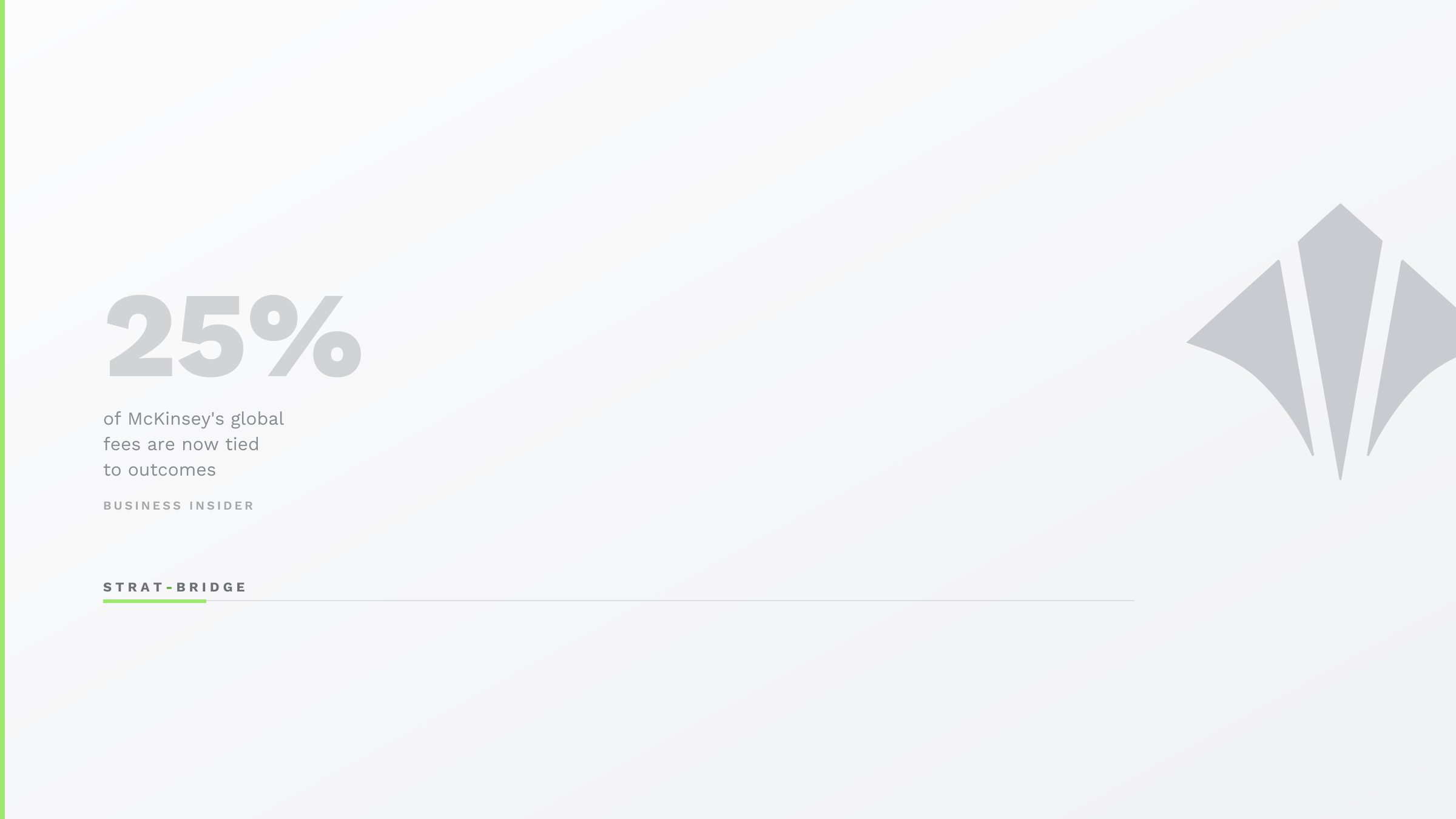
McKinsey is already moving. In November 2025 its UK managing partner, Michael Birshan, put outcome-based pricing at about a quarter of global fees. Business Insider reported the comments.
Cognition’s Art Levy gave Business Insider the new test in a line: “Can you get the job done, and are you cheap at doing it?”
That question will not stay with software vendors. How consulting firms get paid is now the clearest signal of whether they have heard it.
AI-native challengers are going after the work, not the boardroom
AI-native consultancies are not yet trying to replace MBB in the boardroom. Instead, they are going after the delivery work underneath it.
Harvard Business Review described Unity Advisory, launched by former Big Four partners with $300 million of private capital. It runs pods of senior consultants with AI tools instead of a traditional pyramid.
The MBB partner I spoke to added a twist from his own clients in technology services. When he raises AI, they often tell him it is their core business and they will do it themselves.
That is the real threat to stickiness. Not a rival firm winning the relationship. A client deciding the second half of a programme no longer needs an adviser at all.
What will change for MBB and tier-two firms
Over the next three years, client stickiness in strategy consulting will rest less on staffing and more on measured outcomes.
For MBB, the likely path is the one McKinsey is already on. Keep the relationship, plug in whichever agent is strongest that year, and take more of the fee on results. The pyramid shrinks underneath, as growth without adding headcount becomes the norm.
For tier-two firms, the choice is sharper. One option is to go deeper into sectors where a partner’s knowledge is the product. The other is to partner with AI vendors as McKinsey has, and take a thinner slice of a bigger programme.
Both groups face the same pressure on partner economics. A partner whose book depends on large teams billing time will see it shrink, even if the client never leaves. That is why owning the outcome, not just defining it is moving to the centre of the partner role.
What it means for consulting partner hiring
Consulting firms now want partners who bring relationships and a delivery model, not relationships and large teams.
Of course, firms will still pay for people who hold boardroom relationships. That is the stickiness, and it remains worth paying for.
But they will increasingly want partners who can price an outcome and run a smaller team alongside agents. Cognition’s president, Russell Kaplan, made the same point from the vendor side: clients now want to know what a project would have cost without AI.
A partner who cannot answer that question will find the relationship lasts longer than the fees.
Client stickiness is a clock, not a moat
The firms that move first will use the time client stickiness buys them to change how they are paid. They will do it before clients force the issue.
Plenty will still get it wrong by treating a long relationship as proof of value. The client who has worked with you for ten years knows your work best. It is also best placed to spot which half of the programme no longer needs you.
Read the original article
Further reading from Strat-Bridge
- The Strategy House Loses AI Talent FirstAI talent is where lab-backed consultancies like Anthropic x Hg hit strategy firms. Integrators lose revenue first, strategy…
- A Fifth Consulting Model Is Being AssembledThe fifth consulting model is assembled, not built: Ode pairs Anthropic's models with capital, client access and delivery.
- Agent Economics: Consulting’s Next AI BattlegroundEY's Head of Agent Economics signals a new phase for consulting: AI costs, delivery models, margins, talent and…
- Consulting Team Moves & Lift-Outs — how they workPartner-led team moves, practice builds and talent-led acquisition support for consulting firms across the UK, DACH and Europe.…
Work with Strat-Bridge
Strat-Bridge is a retained executive search firm placing Partner & Director-level leaders into strategy and management consulting firms across Europe.
Hiring senior consulting talent? Book a discovery call. Exploring your next leadership move? Join our leadership network.

Ben Appleton is the founder of Strat-Bridge, a specialist executive search partner to the management consulting industry. He works with global consulting firms and senior leaders across the UK, Germany, Switzerland, and beyond — helping them build capability at the Partner and Director level.
Connect with Ben on LinkedIn or email ben@strat-bridge.com.