Summary: Accenture and the Big Four are targeting mid-sized companies as AI makes their work cheaper to deliver, the Financial Times reports. Mid-market consulting is already well served by boutiques and independents, so the real constraint for the large firms is finding partners who work the way those clients expect.
- Accenture launched Accenture Edge in June 2026 for companies with $300mn to $3bn in revenue, and estimates the mid-market segment at $240bn.
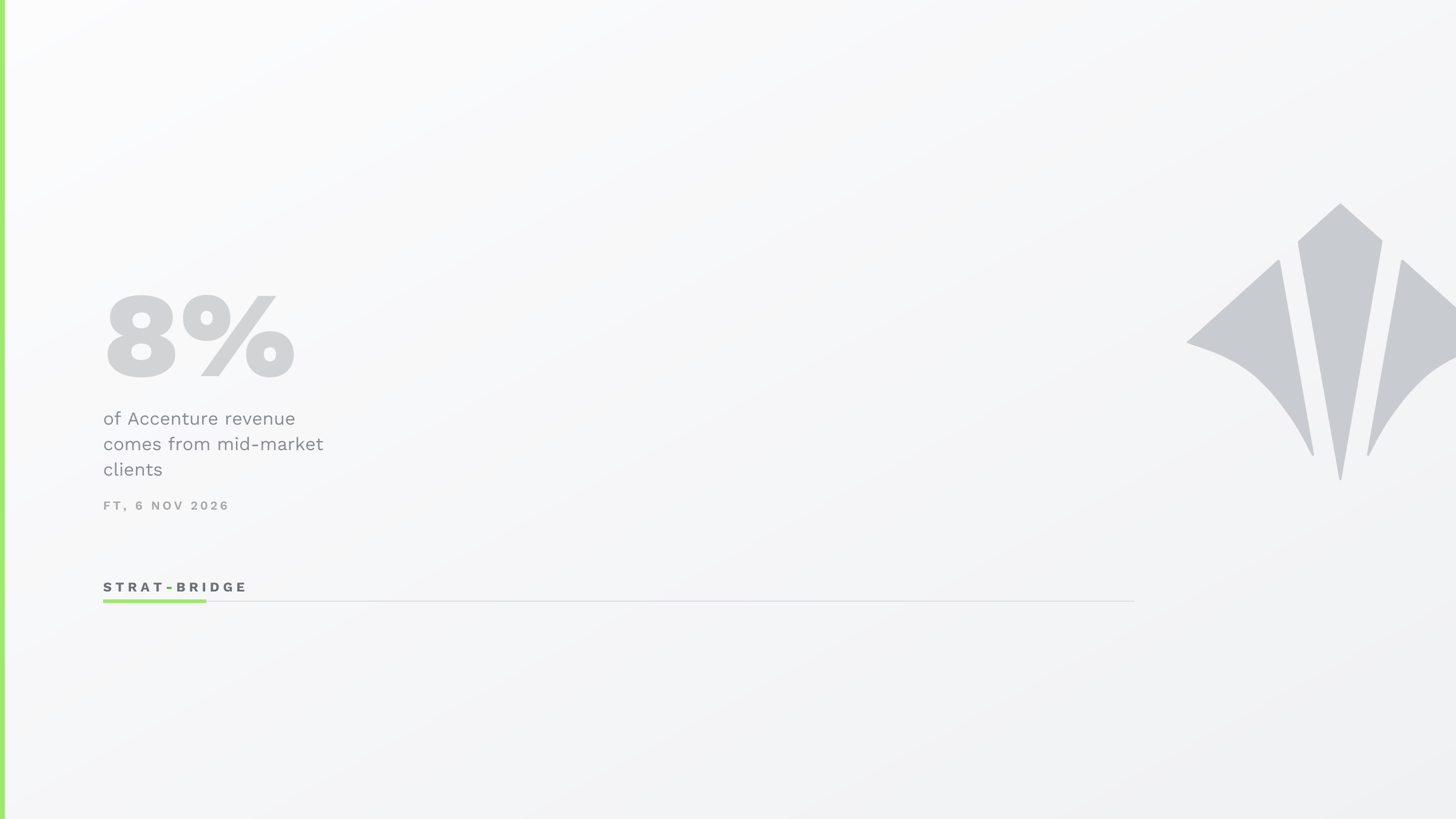
- The mid-market accounts for about 8 per cent of Accenture’s revenue today, roughly one dollar in twelve.
- Mid-market consulting is already served by boutiques, independent consultants and former partners working on a fractional basis.
- The constraint for the large firms is partners who do the work themselves, and many of those people have already chosen to work somewhere smaller.
Mid-market consulting has become the large firms’ growth plan.
The Financial Times reports that Accenture and the Big Four are moving downmarket, targeting smaller companies as AI frees up staff and lets them sell services at lower prices.
Accenture launched a dedicated mid-market unit, Accenture Edge, in June 2026 for companies with annual revenue of $300mn to $3bn. According to the FT, that followed two years of preparation and eight acquisitions.
KPMG’s US firm now asks its audit partners to choose between public and private company work, so that private clients get dedicated teams. It told the FT that private companies are its fastest-growing client segment across audit, tax and advisory.
PwC and EY have both invested in their existing middle-market businesses as well.
You can see the appeal. But these firms are entering a market with plenty of good advisers already in it.
Winning mid-market work takes more than cheaper delivery; it takes partners who work the way these clients expect.
Why the big firms want mid-market consulting work
The large firms want mid-market consulting work because growth from their blue-chip clients has slowed and AI has left them with capacity to redeploy. Research group Source Global expects the US consulting market to grow about 8 per cent this year, the FT reports. That is better than the last two years and well short of the double-digit growth that followed the pandemic.
KPMG was candid about the other half of it. Christian Peo, KPMG’s US vice-chair for audit and assurance, told the FT that without new markets the firm would, all else being equal, have to shrink its workforce.
The prize is large. Accenture puts the mid-market segment at $240bn and growing at high single digits. For a firm where headcount no longer drives growth, that is hard to ignore.
It is not a new idea. Fiona Czerniawska, chief executive of Source Global, makes the point in the FT piece that big firms rediscover the middle market every time their large clients spend less, and tend to forget it again in between.
AI has changed the delivery economics
AI has made some consulting work cheap enough to sell to mid-sized clients at a margin the large firms can accept. EY told the FT it can now sell due diligence at a lower cost than when the work needed more people and more time.
Manish Sharma, Accenture’s chief strategy and services officer, describes the model as pre-built, tightly scoped and standardised. Accenture Edge has since announced agentic AI products with Google Cloud aimed at the same segment.
That is a product business as much as an advisory one. It is another reason to watch how firms get paid and not only what they say about AI.
The large firms are not the only new arrivals. The FT notes that Anthropic’s joint venture with private equity groups including Blackstone is aimed at mid-sized companies too, which is why the lab-backed consultancy model matters here.
Mid-market consulting already has good advisers
Mid-market consulting is already well served by boutiques, independent consultants and former partners working on a fractional basis. They have spent years building those relationships.
In Germany’s Mittelstand, knowing the owner and understanding the business counts for a lot. It is one of the reasons Germany’s consulting market is splitting between the global firms and the specialists.
The mid-tier accounting and advisory firms are not standing still either. Grant Thornton has made three tech-focused acquisitions in the past year and a half and RSM has stepped up its hunt for deals, the FT reports. Jim Peko, chief executive of Grant Thornton Advisors, told the FT that any firm can decide to pursue the middle market, but “serving it exceptionally well is different”.
It is worth keeping the scale in proportion. The mid-market accounts for about 8 per cent of Accenture’s revenue, according to the company. That is roughly one dollar in twelve.
There is room to grow, but a recognisable name only gets you so far.
The pyramid is becoming a diamond
The large firms’ staffing model is moving from a pyramid to a diamond, with far fewer juniors under each partner. One Big Four senior manager described his firm to me in exactly those terms: one partner and three senior managers, where there used to be a bench of juniors.
That is the less discussed driver of the mid-market push. The big firms need work for their senior people.
We have written before about the move from leverage to judgment, and about why principals face the real squeeze. A diamond-shaped firm has a lot of experienced people and fewer large programmes to put them on.
As one Big Four partner put it to us, the time of administering big teams is over.
What a mid-market CEO expects from a partner
A mid-market CEO expects the person they hired to pick up the phone, know the detail and do the work.
A mid-market CEO expects the person they hired to pick up the phone, know the detail and do the work.Ben Appleton, Strat-Bridge
That asks something different of partners who have spent years overseeing large delivery teams.
One principal at a large technology consultancy told me he manages about €10m of revenue a year. Strategy work is 10 to 15 per cent of it and the rest is delivery. On the very largest deals he contributes to the sale; he does not lead it.
That is no criticism of him. It is what the model rewards. But a mid-sized client is buying the individual, and the Big Four network effect counts for less when the buyer wants one person who knows the business.
The same Big Four partner was honest about where the gap sits. Mid-cap private equity portfolio work, he said, is where his own firm does not really act well.
Boutiques have a scale problem of their own
Boutiques hold the relationships in the mid-market but lack the scale to build low-cost, AI-enabled delivery themselves. A large firm can set up delivery centres and balance the cost of AI against the cost of people. A firm of 30 cannot, and has to decide what to outsource and to whom.
The demand is there. A founder who spent years selling AI work to German companies with €100m to €1bn in revenue told me the segment is still underserved.
He added that private equity firms are now approaching the same senior AI people for value creation roles. That makes three sets of buyers for one small group of people.
Who wins mid-market consulting from here
The firms that win mid-market consulting will pair cheaper, AI-enabled delivery with partners that clients actually want to deal with. That has hiring implications. Some of the people best suited to this work are already at boutiques or working for themselves. They have the relationships, and many have chosen that way of working for a reason, which is why the expert partner needs its own deal.
The risk for the large firms is treating this as a pricing question. The harder question is the one the launch announcements leave open. What would persuade those people to join a big firm?
Read the original article
Further reading from Strat-Bridge
- Consulting Headcount No Longer Drives GrowthConsulting headcount no longer drives growth. Accenture's FY26 results show AI lifting revenue per person and reshaping senior…
- The Anthropic Consultancy Runs Through PEThe Anthropic consultancy with Hg routes enterprise AI through private equity. What it means for Accenture, the Big…
- Consulting Principals Face the Real SqueezeConsulting principals must deliver and sell as AI shrinks junior teams. What the FT argues, and why the…
- Consulting Team Moves & Lift-Outs — how they workPartner-led team moves, practice builds and talent-led acquisition support for consulting firms across the UK, DACH and Europe.…
Work with Strat-Bridge
Strat-Bridge is a retained executive search firm placing Partner & Director-level leaders into strategy and management consulting firms across Europe.
Hiring senior consulting talent? Book a discovery call. Exploring your next leadership move? Join our leadership network.

Ben Appleton is the founder of Strat-Bridge, a specialist executive search partner to the management consulting industry. He works with global consulting firms and senior leaders across the UK, Germany, Switzerland, and beyond — helping them build capability at the Partner and Director level.
Connect with Ben on LinkedIn or email ben@strat-bridge.com.